LinkedIn Pinpoint #861 Hints & Answer: Crust & Mantle
You are viewing the Sep 8 puzzle, #861. View the latest Pinpoint answer
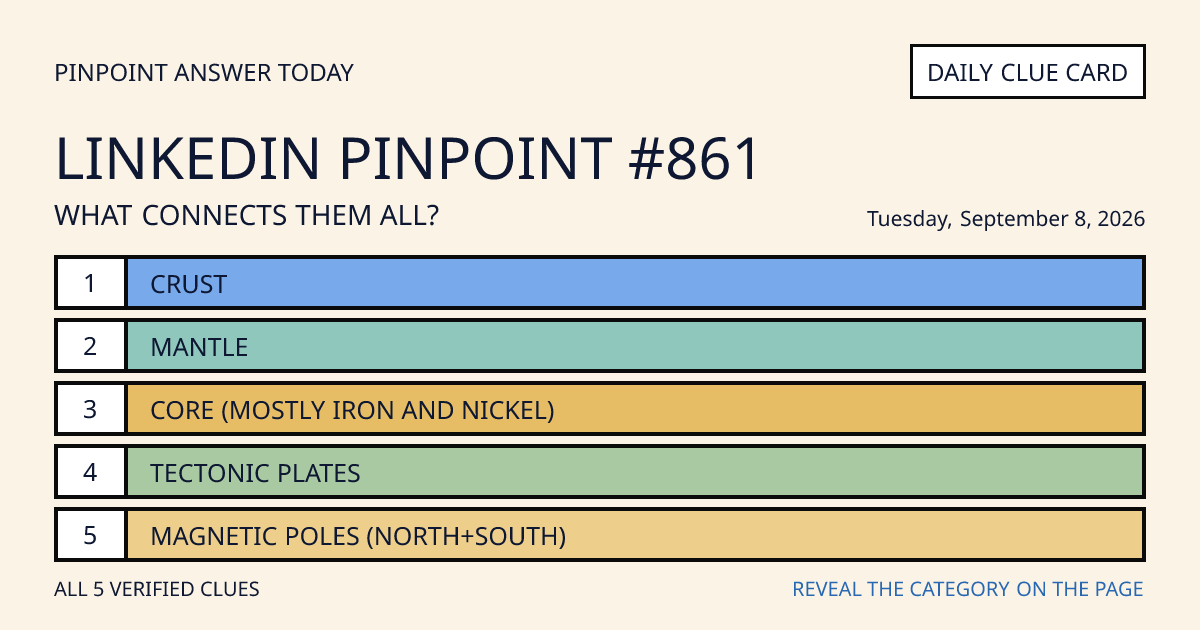
Pinpoint #861 opens with Crust, Mantle, and Core (mostly iron and nickel). Compare all five clues below, then reveal the category and its connections.
Edited reference guide · AI-assisted ·
Original game: LinkedIn Pinpoint. Pinpoint Answer Today is an independent, unofficial puzzle guide. We are not affiliated with, sponsored by, or endorsed by LinkedIn or Microsoft.
Reveal answer & analysis
The answer is “Parts of the Earth.” Crust, mantle and core establish the planet's interior; tectonic plates and magnetic poles broaden the set to its structure and magnetic features. Not all five clues name layers.
5 Clues
- Clue 1Crust
- Clue 2Mantle
- Clue 3Core (mostly iron and nickel)
- Clue 4Tectonic plates
- Clue 5Magnetic poles (North+South)
Why this answer fits
A layers-only answer fits Crust and Mantle but becomes too narrow at Tectonic plates and Magnetic poles. Clue three supports an Earth-science reading; iron and nickel alone are not unique to Earth, so the whole set matters. Treat the last two clues as a test of the category's scope, rather than forcing them into a list of concentric layers. NASA's linked reference supports the scientific context; the category wording comes from the puzzle record.
Solving path for Pinpoint #861
- Initial reading: Start with Crust and Mantle. Their combination makes Earth's internal structure a strong candidate, although crust alone can also refer to food.
- Testing the connection: Add Core (mostly iron and nickel). It supports the planetary context, without claiming that this chemical composition identifies Earth uniquely.
- Final check: Test Tectonic plates and Magnetic poles (North+South). They are not two more interior layers, so widen the rule to Parts of the Earth, the supplied category.
Clue-by-clue explanation
| Clue | Connection evidence |
|---|---|
| Crust | Crust is Earth's outer rocky layer. Its food meaning becomes unlikely beside Mantle and Core. |
| Mantle | Mantle names the layer beneath the crust, supporting the internal-structure reading of the opening pair. |
| Core (mostly iron and nickel) | Core (mostly iron and nickel) refers to the central region. Earth has an inner and outer core, not one uniform solid component. |
| Tectonic plates | Tectonic plates are pieces of the lithosphere, including crust and rigid uppermost mantle, rather than another layer beneath the core. |
| Magnetic poles (North+South) | Magnetic poles (North+South) are magnetic-field features, not solid interior components. Earth's field involves moving conductive material in its outer core. |
Questions about Pinpoint #861
What do Crust, Mantle, and Core (mostly iron and nickel) have in common? (answer spoiler)
The shared category is Parts of the Earth.
A layers-only answer fits Crust and Mantle but becomes too narrow at Tectonic plates and Magnetic poles. Clue three supports an Earth-science reading; iron and nickel alone are not unique to Earth, so the whole set matters. Treat the last two clues as a test of the category's scope, rather than forcing them into a list of concentric layers. NASA's linked reference supports the scientific context; the category wording comes from the puzzle record.
What does “Crust” mean in this puzzle? (answer spoiler)
Crust is Earth's outer rocky layer. Its food meaning becomes unlikely beside Mantle and Core.
What does “Mantle” mean in this puzzle? (answer spoiler)
Mantle names the layer beneath the crust, supporting the internal-structure reading of the opening pair.
Looking for today's puzzle?
This edition is dated Tuesday, September 8, 2026. Visit today's Pinpoint answer for the latest edition, or browse the archive.
Sources — may contain answer spoilers
These references support the explanation notes; they do not certify human review.
- NASA Science — Facts About EarthReference for Earth's layers, tectonic structure and magnetic field, not a claim that all five clues are layers.
- NASA — Cut-away Diagram of Earth's InteriorExplains the moving conductive outer core's relationship to Earth's magnetic field.
 X / Twitter
 LinkedIn
 Reddit