LinkedIn Pinpoint #753 Hints & Answer: Titan & Triton
LinkedIn Pinpoint #753 for Saturday, May 23, 2026 starts with “Titan” and “Triton”. Explore the clues below, then reveal the category and how each clue connects.
Edited reference guide · AI-assisted ·
Original game: LinkedIn Pinpoint. Our explanations are independently written; this site is not affiliated with LinkedIn or Microsoft.
Latest edition: Looking for the current puzzle instead? See today's LinkedIn Pinpoint answer →
Reveal answer & analysis
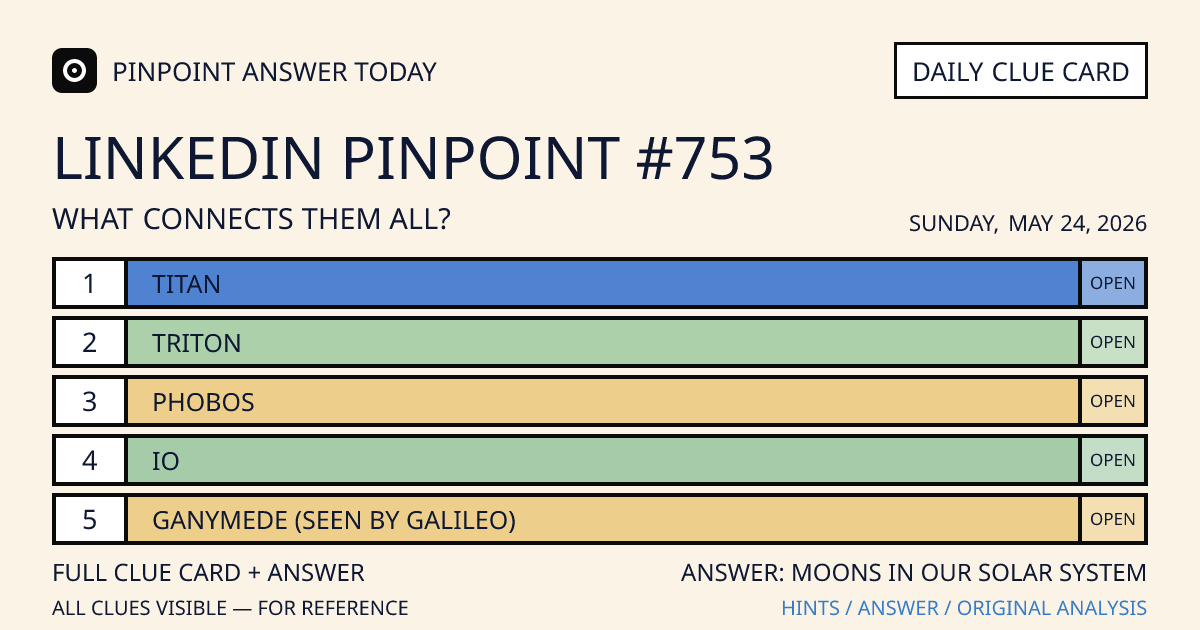
Titan, Triton, Phobos, Io, and Ganymede are natural satellites orbiting planets in our solar system.
5 Clues
- Clue 1Titan
- Clue 2Triton
- Clue 3Phobos
- Clue 4Io
- Clue 5Ganymede (seen by Galileo)
Why this answer fits
Titan and Ganymede are large, famous moons. Phobos, Io, and Triton then distribute the set across Mars, Jupiter, and Neptune.
Quick wink: Phobos feared the answer would be difficult; Io kept erupting with suggestions.
How to find the connection
- Start with Titan and Ganymede, well-known large moons of Saturn and Jupiter.
- Add Io and Triton, satellites with distinctive volcanic and icy characteristics.
- Identify Phobos as a moon of Mars, confirming that all five are solar-system moons.
Clue-by-clue explanation
| Clue | Connection evidence |
|---|---|
| Titan | Titan is Saturn’s largest moon and has a dense atmosphere rich in nitrogen. |
| Triton | Triton is Neptune’s largest moon and follows a retrograde orbit. |
| Phobos | Phobos is the larger and innermost of Mars’s two small moons. |
| Io | Io is a moon of Jupiter and the most volcanically active body known in the solar system. |
| Ganymede (seen by Galileo) | Ganymede orbits Jupiter and is the largest moon in the solar system. |
Questions about Pinpoint #753
Which clues start this puzzle?
The first two clues are “Titan” and “Triton”. The complete five-clue list is above.
Where is the category answer?
Open “Reveal answer & analysis” above to see the category and a separate explanation for each clue.
Looking for today's puzzle?
This edition is dated Saturday, May 23, 2026. Visit today's Pinpoint answer for the latest edition, or browse the archive.
Sources
These references support the explanation notes; they do not certify human review.
- NASA — Moons: FactsIdentifies the parent planets of the five moons, Ganymede's size, and Triton's retrograde orbit.
- NASA — Titan FactsSupports Titan's size and dense nitrogen-rich atmosphere.
- NASA — Io FactsSupports Io's exceptional volcanic activity.
 X / Twitter
 LinkedIn
 Reddit