LinkedIn Pinpoint #841 Hints & Answer: William and Caroline Herschel & Tycho Brahe
LinkedIn Pinpoint #841 for Wednesday, August 19, 2026 starts with “William and Caroline Herschel” and “Tycho Brahe”. Explore the clues below, then reveal the category and how each clue connects.
Automated explanation · not human reviewed ·
Original game: LinkedIn Pinpoint. Our explanations are independently written; this site is not affiliated with LinkedIn or Microsoft.
Latest edition: Looking for the current puzzle instead? See today's LinkedIn Pinpoint answer →
Reveal answer & analysis
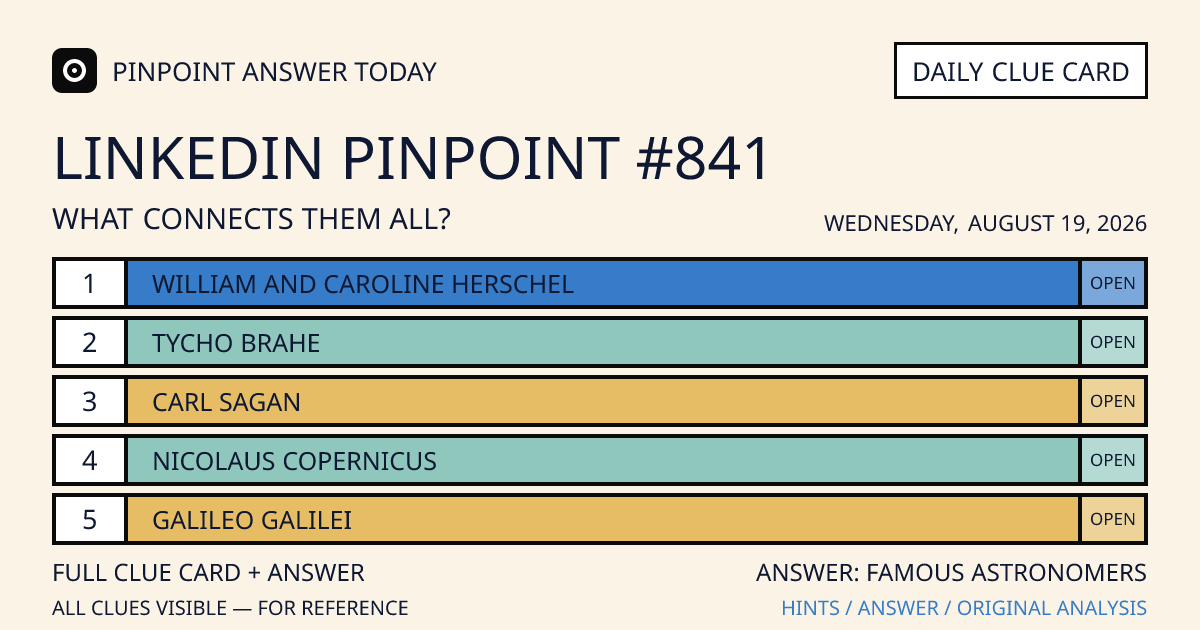
William and Caroline Herschel, Tycho Brahe, Carl Sagan, Nicolaus Copernicus, and Galileo Galilei are all famous astronomers. The clues cross several centuries, from Renaissance challenges to an Earth-centered cosmos to modern explanations that brought astronomy into living rooms.
5 Clues
- Clue 1William and Caroline Herschel
- Clue 2Tycho Brahe
- Clue 3Carl Sagan
- Clue 4Nicolaus Copernicus
- Clue 5Galileo Galilei
Why this answer fits
Copernicus and Galileo form the quickest historical pair because both are central to the development and defense of heliocentric astronomy. Tycho Brahe adds precise pre-telescopic observations, the Herschels bring discoveries made through systematic sky surveys, and Carl Sagan confirms that the category is people known for astronomy rather than one particular theory or century.
Quick wink: Five astronomers entered one category, and not one of them asked for more space. That may be a first for the field.
How to find the connection
- Start with Nicolaus Copernicus and Galileo Galilei. Their shared place in the history of heliocentric astronomy makes ‘astronomers’ the strongest first hypothesis.
- Test Tycho Brahe and William and Caroline Herschel. Brahe is known for exceptionally precise observations, while the Herschels are associated with telescopic surveys and major discoveries, so the same profession fits across different eras.
- Finish with Carl Sagan. His scientific research and public communication of astronomy rule out a narrower answer such as Renaissance scientists, confirming the category ‘Famous astronomers.’
Clue-by-clue explanation
| Clue | Connection evidence |
|---|---|
| William and Caroline Herschel | William Herschel discovered Uranus and conducted extensive telescopic surveys; his sister Caroline Herschel discovered several comets and produced influential astronomical catalog work. |
| Tycho Brahe | Tycho Brahe made exceptionally accurate naked-eye measurements of stars and planets before the telescope became an astronomical instrument. |
| Carl Sagan | Carl Sagan was an astronomer and planetary scientist who also made astronomy widely accessible through books and the television series Cosmos. |
| Nicolaus Copernicus | Nicolaus Copernicus developed the influential heliocentric model that placed the Sun, rather than Earth, near the center of the known planetary system. |
| Galileo Galilei | Galileo Galilei used telescopic observations—including moons orbiting Jupiter and the phases of Venus—to provide important evidence against a strictly Earth-centered cosmos. |
Questions about Pinpoint #841
Which clues start this puzzle?
The first two clues are “William and Caroline Herschel” and “Tycho Brahe”. The complete five-clue list is above.
Where is the category answer?
Open “Reveal answer & analysis” above to see the category and a separate explanation for each clue.
Looking for today's puzzle?
This edition is dated Wednesday, August 19, 2026. Visit today's Pinpoint answer for the latest edition, or browse the archive.
Sources
These references support the explanation notes; they do not certify human review.
- NASA StarChild — Who’s Who in SpaceNASA biography index covering Tycho Brahe, Nicolaus Copernicus, Galileo Galilei, Caroline Herschel, and Carl Sagan.
 X / Twitter
 LinkedIn
 Reddit