Dataset correction — September 9, 2026
The original snapshot used below contains a transcription error in #751: Great Horned belongs together in clue four, and Hoot begins clue five. The original snapshot and infographic are retained as version 1, not presented as an error-free record. The article correction is based on corroborating historical sources, not an original official screenshot.
With that boundary repaired, the five mean character counts are 6.31, 7.04, 8.19, 9.46, 13.90; single-word counts are 271, 250, 227, 206, 134. The broad increasing-length pattern remains. Both input versions and their measurements are provided in the data JSON.
The short answer
Do not marry your first theory
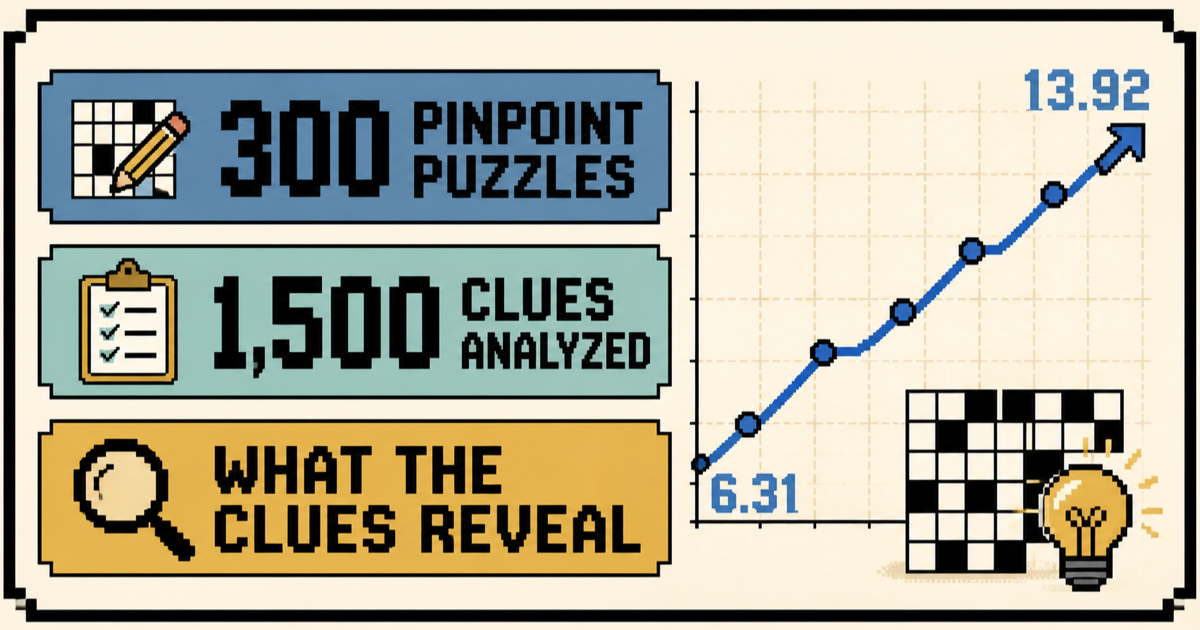
Clue 1 is a one-word prompt in 90.3% of the records we analyzed. By clue 5, that figure falls to 44.7%, while average clue length more than doubles from 6.31 to 13.92 characters. This measures wording, not the difficulty of a clue or the designer’s intention.
The practical lesson is simple: use the first clue to generate candidates, not to crown a winner. As a solving heuristic, use the fourth and fifth clues to challenge that candidate; the study did not test player success rates.
Finding 1: later clues are longer on average
The average character count rises at every reveal. The biggest jump occurs between clues 4 and 5, when average length increases by 4.48 characters. A longer clue can offer more context, but length alone does not establish that it is easier or more informative.
| Position | Average characters | One-word clues | One-word share |
|---|---|---|---|
| Clue 1 | 6.31 | 271 of 300 | 90.3% |
| Clue 2 | 7.04 | 250 of 300 | 83.3% |
| Clue 3 | 8.19 | 227 of 300 | 75.7% |
| Clue 4 | 9.44 | 207 of 300 | 69.0% |
| Clue 5 | 13.92 | 134 of 300 | 44.7% |
Across all positions: 1,089 of 1,500 clues were a single word (72.6%). The median clue length was seven characters; the mean was 8.98.
Finding 2: a clue word is not a category
After lowercasing and removing punctuation, 98 distinct clue phrases appeared in at least two puzzles. Several appeared three times—but pointed to unrelated answers.
“Baby”
#680: shades of blue
#667: types of bottle
#574: words before “shower”
“Cold”
#816: meanings of “bug”
#799: words before “cream”
#574: words before “shower”
“Class”
#803: biological taxonomy
#641: words after “master”
#565: things you can skip
“Spring”
#740: parts of a pen
#692: drinking-water sources
#547: types of water
This is why memorizing clue-to-answer pairs is brittle. A strong solve must explain the whole set, including the grammatical relationship between each clue and the proposed category.
Finding 3: phrase-building deserves an early test
We assigned each answer label to the first matching text pattern in the order shown below. “Before” and “after/follow” labels account for 87 of 300 puzzles—29.0% of the archive. That does not mean the answer is usually a phrase construction, but it is common enough to test before inventing a very broad semantic category.
| Answer-label family | Records | Share |
|---|---|---|
| Things… | 70 | 23.3% |
| Words that come before… | 57 | 19.0% |
| Types/kinds of… | 34 | 11.3% |
| Words that come after/follow… | 30 | 10.0% |
| Names of… | 9 | 3.0% |
| All other labels | 100 | 33.3% |
A data-backed Pinpoint answer routine
- GenerateAfter clue 1, write two or three category candidates. Do not submit yet.
- Test grammarAsk whether every clue could sit before or after the same word.
- Try to disproveUse clue 3 or 4 to break your favorite theory, not merely support it.
- Spend clue 5 wiselyReveal it when two candidates survive; its extra specificity is most valuable then.
Methodology and limitations
- Dataset: 300 archived records numbered 525 through 825; record 756 was unavailable and excluded.
- Counts: words were split on whitespace; characters were counted after trimming; punctuation and case were removed only for repeat detection.
- Answer families: the label classification was mutually exclusive and text-based, so it describes wording in this archive—not every possible semantic category.
- Scope: live puzzles after #825 were not included, and the archive may contain transcription errors inherited from public puzzle records.
- Reproducibility: all 300 input records and the measured results are available in the study data JSON. The public article archive is selective and does not contain a full guide for every record.
- Inference: length and word counts do not measure clue difficulty, player success or the designer's intention. Solving recommendations are interpretations, not experimental findings.
Reproduce the clue-length table
Open the 300 input records and calculated results →
For each position, trim the clue text and count Unicode characters. Add those counts and divide by 300. For the single-word share, count clues that split into one token on whitespace, then divide by 300 and multiply by 100. The displayed table and downloadable results use the same calculation.
Calculation cross-check: September 8, 2026. No new puzzle records were added to this sample.
Use the findings
How to cite this analysis
Pinpoint Answer Today. “300 LinkedIn Pinpoint Answers Analyzed: What the Clues Reveal.” Published August 9, 2026. https://pinpointanswertoday.co/research/linkedin-pinpoint-clue-study