LinkedIn Pinpoint #916 Hints & Answer: Body & Greeting
You are viewing the Nov 2 puzzle, #916. View the latest Pinpoint answer
Pinpoint #916 opens with Body, Greeting, and Address. Compare all five clues below, then reveal the category and its connections.
AI-assisted explanation · automated checks ·
Original game: LinkedIn Pinpoint. Pinpoint Answer Today is an independent, unofficial puzzle guide. We are not affiliated with, sponsored by, or endorsed by LinkedIn or Microsoft.
Need a hint first?
Reveal one hint at a time.
Hint 1 — a direction to explore
Think about how a formal message is typically laid out from start to finish.
Hint 2 — narrow the relationship
Several clues suggest an opener, a main section, a closing identifier, and a destination line.
Hint 3 — one more nudge
One clue refers to an add-on that conventionally comes after everything else is done.
First two clues: possible connections
“Body” could point to anatomy, a physical object’s main mass, or the central text section of a message. “Greeting” could be an in-person hello, a seasonal phrase on a card, or a formal salutation. With only these two, multiple themes remain plausible and the intended category is not yet determined.
Reveal answer & analysis
All five clues point to standard components that appear in formatted correspondence, from the opening salutation through the postscript.
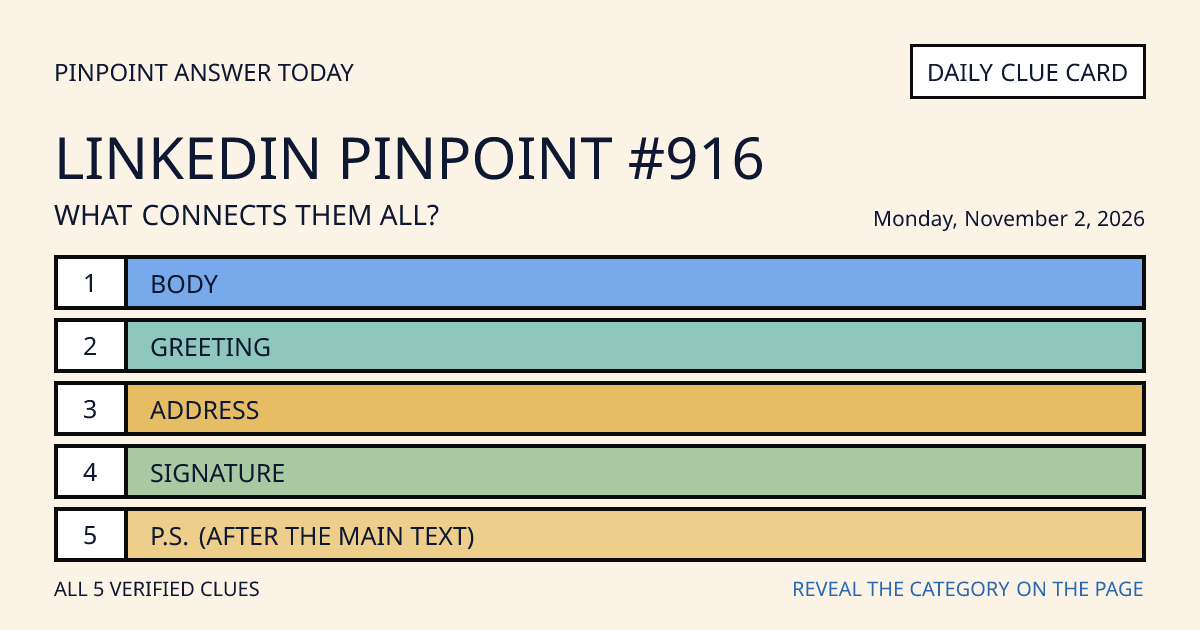
5 Clues
- Clue 1Body
- Clue 2Greeting
- Clue 3Address
- Clue 4Signature
- Clue 5P.S. (after the main text)
Why this answer fits
Each clue names a conventional section used to structure a letter or email: opener, core content, destination info, author sign-off, and an add-on after completion. The ambiguity is that “Body” and “Greeting” could fit many everyday contexts, but “Address” and “Signature” push toward formatted correspondence. “P.S.” then locks in the specific convention of adding a postscript after the main message.
Solving path for Pinpoint #916
- Initial reading: Start by listing multiple senses for “Body” and “Greeting,” since they can describe anatomy, social interaction, or the structure of a message.
- Testing the connection: Test the “message structure” idea against “Address” and “Signature,” which naturally function as recipient information and author sign-off in correspondence.
- Final check: Confirm the exact scope with “P.S. (after the main text),” which specifically names the postscript convention used in letters and emails.
Clue-by-clue explanation
| Clue | Meaning in this puzzle | Connection & role in the solve |
|---|---|---|
| Body | Body (main text of a message)The primary block of content where the sender explains the purpose and details, excluding the salutation and closing. | “Body” fits because it names the central content section of written correspondence (letter or email). |
| Greeting | Greeting (salutation)An opening line addressing the recipient, such as “Dear Jordan,” or “Hi there,” placed before the main content. | “Greeting” fits because it is the standard salutation that begins written correspondence (letter or email). |
| Address | Address (recipient details / addressing line)Information that specifies who the message is directed to, such as a postal address block or an email addressing field. | “Address” fits because it indicates the recipient’s identifying destination information used in written correspondence (letter or email). |
| Signature | Signature (sign-off name)The sender’s name and optional details placed at the end to confirm authorship and provide contact information. | “Signature” fits because it is the named closing identifier used to end written correspondence (letter or email). |
| P.S. (after the main text) | P.S. (postscript)A short additional note appended after the main message, traditionally placed after the signature as an afterthought. | “P.S. (after the main text)” fits because a postscript is a conventional add-on placed after the main message in written correspondence (letter or email). |
One lesson to use next time
When early clues are broad (“Body,” “Greeting”), look for later terms that imply a standardized layout; “Address,” “Signature,” and especially “P.S.” strongly indicate letter/email structure.
Questions about Pinpoint #916
What do Body, Greeting, and Address have in common? (answer spoiler)
The shared category is Parts of written correspondence (letter or email).
Each clue names a conventional section used to structure a letter or email: opener, core content, destination info, author sign-off, and an add-on after completion. The ambiguity is that “Body” and “Greeting” could fit many everyday contexts, but “Address” and “Signature” push toward formatted correspondence. “P.S.” then locks in the specific convention of adding a postscript after the main message.
What does “Body” mean in this puzzle? (answer spoiler)
Body (main text of a message): The primary block of content where the sender explains the purpose and details, excluding the salutation and closing. “Body” fits because it names the central content section of written correspondence (letter or email).
What does “Greeting” mean in this puzzle? (answer spoiler)
Greeting (salutation): An opening line addressing the recipient, such as “Dear Jordan,” or “Hi there,” placed before the main content. “Greeting” fits because it is the standard salutation that begins written correspondence (letter or email).
Looking for today's puzzle?
This edition is dated Monday, November 2, 2026. Visit today's Pinpoint answer for the latest edition, or browse the archive.
 X / Twitter
 LinkedIn
 Reddit