LinkedIn Pinpoint #914 Hints & Answer: Books & Cacti
You are viewing the Oct 31 puzzle, #914. View the latest Pinpoint answer
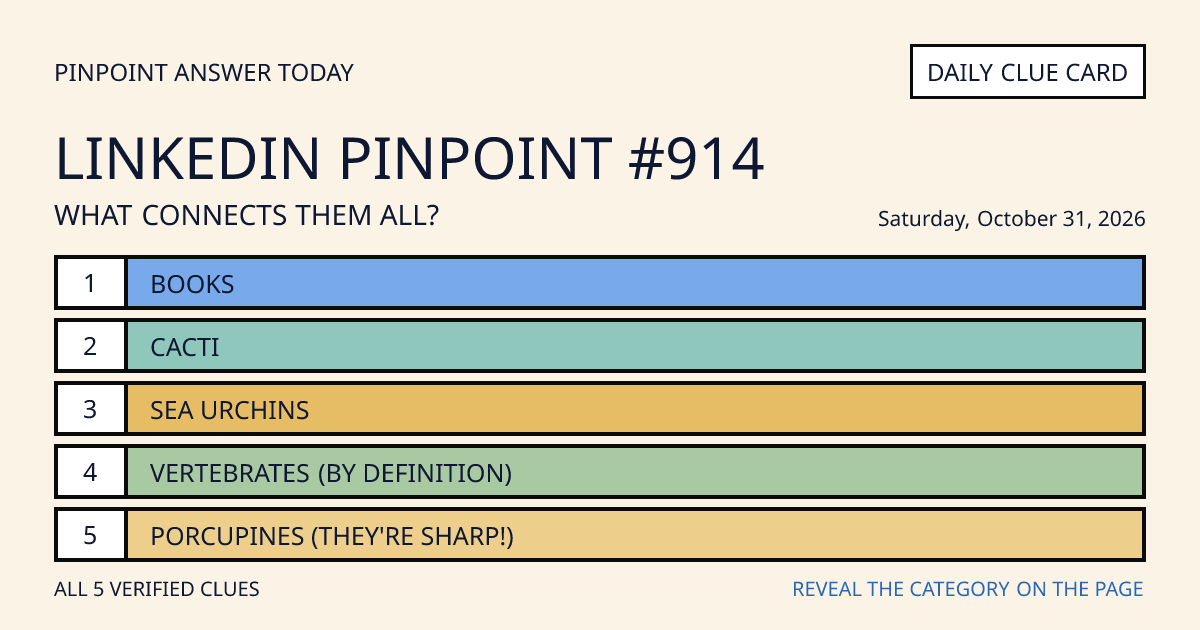
Pinpoint #914 opens with Books, Cacti, and Sea urchins. Compare all five clues below, then reveal the category and its connections.
AI-assisted explanation · automated checks ·
Original game: LinkedIn Pinpoint. Pinpoint Answer Today is an independent, unofficial puzzle guide. We are not affiliated with, sponsored by, or endorsed by LinkedIn or Microsoft.
Need a hint first?
Reveal one hint at a time.
Hint 1 — a direction to explore
Consider a single named structural support that can be part of an object and also part of an animal’s anatomy.
Hint 2 — narrow the relationship
That same term can describe an external protective feature, not only an internal framework.
Hint 3 — one more nudge
Try the word used for a book’s binding edge, then check whether it also applies to cacti and several kinds of animals.
First two clues: possible connections
With Books and Cacti, the overlap could point toward "sharp/pointy" ideas (needles, thorns) or toward parts of a physical object (covers, bindings). It could also be heading toward a shared named feature that exists both in bookmaking and in plant anatomy, so those two alone don’t uniquely determine the category.
Reveal answer & analysis
These clues jump across publishing, desert botany, marine life, formal zoological definitions, and a famously prickly mammal defense system.
5 Clues
- Clue 1Books
- Clue 2Cacti
- Clue 3Sea urchins
- Clue 4Vertebrates (by definition)
- Clue 5Porcupines (they're sharp!)
Why this answer fits
The shared category is "Things with spines." Here, "spine" shifts meaning: it can be a bookbinding edge, an internal vertebral column, or an external sharp projection (as on cacti and sea urchins). Porcupines land on the everyday “sharp spine” sense via quills that serve the same defensive role.
Solving path for Pinpoint #914
- Initial reading: Start by listing multiple senses suggested by Books and Cacti: book parts (binding edge), plant defenses (sharp growths), or a broader “supporting structure” idea; note the first two clues don’t force one path.
- Testing the connection: Test a candidate shared term against Sea urchins and Vertebrates (by definition): it must cover both external projections and an internal anatomical column without stretching definitions.
- Final check: Confirm the final category fits Porcupines (they're sharp!) as well, allowing for the everyday defensive sense (quills) alongside the bookbinding and anatomical senses.
Clue-by-clue explanation
| Clue | Meaning in this puzzle | Connection & role in the solve |
|---|---|---|
| Books | Book spineThe bound edge of a book that holds the pages together and often carries the title and author text. | Books belong because a book has a spine as part of its physical binding. |
| Cacti | Cactus spinesSharp, rigid growths on a cactus that provide protection and discourage animals from eating the plant. | Cacti belong because Cacti commonly bear spines as their sharp protective structures. |
| Sea urchins | Sea urchin spinesMovable, pointed projections on a sea urchin used for defense and for helping the animal move. | Sea urchins belong because Sea urchins are covered with many spines projecting from their hard body surface. |
| Vertebrates (by definition) | Vertebrate spine (vertebral column)The internal column of vertebrae that supports the body and protects the spinal cord in vertebrate animals. | Vertebrates (by definition) belong because Vertebrates (by definition) have a spine/vertebral column. |
| Porcupines (they're sharp!) | Porcupine quills (defensive spines)Stiff, sharp keratin quills on a porcupine’s body that can embed in threats as a defense. | Porcupines (they're sharp!) belong because Porcupines (they're sharp!) have quills that function as defensive spines. |
One lesson to use next time
When a set mixes artifacts and organisms, test whether the link is a shared term with multiple senses (bookbinding vs. anatomy vs. protective projections) rather than a single literal feature.
Questions about Pinpoint #914
What do Books, Cacti, and Sea urchins have in common? (answer spoiler)
The shared category is Things with spines.
The shared category is "Things with spines." Here, "spine" shifts meaning: it can be a bookbinding edge, an internal vertebral column, or an external sharp projection (as on cacti and sea urchins). Porcupines land on the everyday “sharp spine” sense via quills that serve the same defensive role.
What does “Books” mean in this puzzle? (answer spoiler)
Book spine: The bound edge of a book that holds the pages together and often carries the title and author text. Books belong because a book has a spine as part of its physical binding.
What does “Cacti” mean in this puzzle? (answer spoiler)
Cactus spines: Sharp, rigid growths on a cactus that provide protection and discourage animals from eating the plant. Cacti belong because Cacti commonly bear spines as their sharp protective structures.
Looking for today's puzzle?
This edition is dated Saturday, October 31, 2026. Visit today's Pinpoint answer for the latest edition, or browse the archive.
 X / Twitter
 LinkedIn
 Reddit