LinkedIn Pinpoint #862 Hints & Answer: Iron & Golden
You are viewing the Sep 9 puzzle, #862. View the latest Pinpoint answer
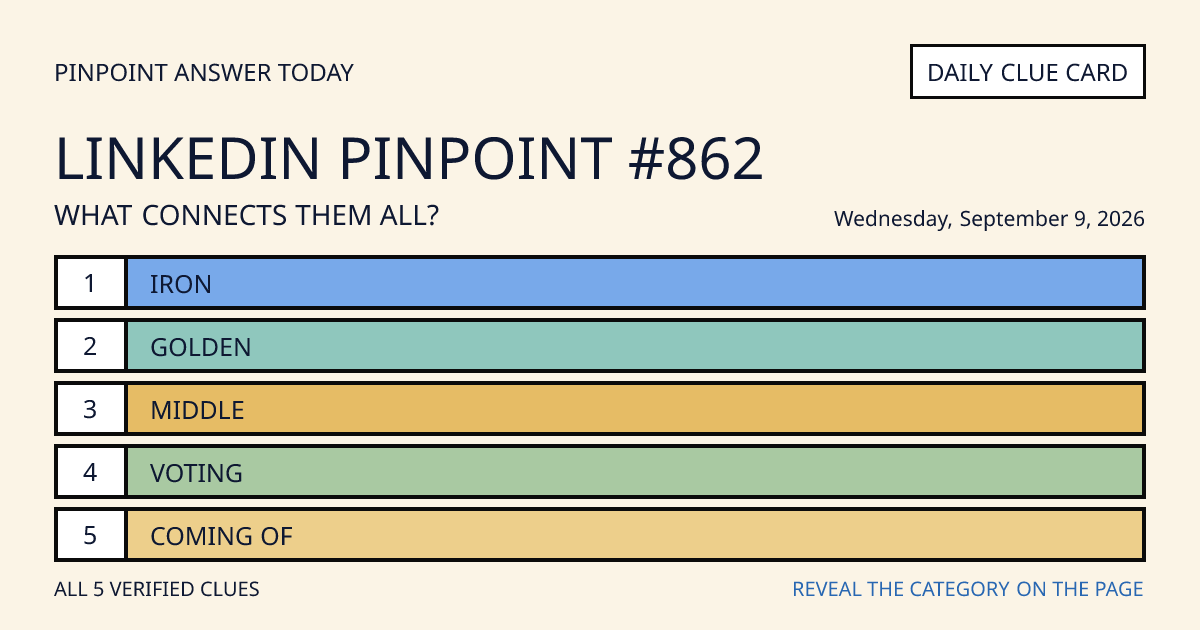
Pinpoint #862 opens with Iron, Golden, and Middle. Compare all five clues below, then reveal the category and its connections.
AI-assisted explanation · automated checks ·
Original game: LinkedIn Pinpoint. Pinpoint Answer Today is an independent, unofficial puzzle guide. We are not affiliated with, sponsored by, or endorsed by LinkedIn or Microsoft.
Reveal answer & analysis
The answer is: Words that come before “age”. Each clue is a common modifier that pairs naturally with the word “age” to form a familiar phrase: Iron Age, Golden Age, Middle Age, voting age, and coming of age. The set spans historical eras, a life-stage milestone, and a legal/social threshold, but the unifying mechanism is simply the same trailing word completing every entry.
5 Clues
- Clue 1Iron
- Clue 2Golden
- Clue 3Middle
- Clue 4Voting
- Clue 5Coming of
Why this answer fits
A tempting alternative category is “types of ages” or “ways to describe being old,” since “middle age” and “coming of age” both relate to life stages. That reading breaks down once “Iron” and “Golden” appear, because those are best known as labels for eras when they directly precede “Age” in standard phrases. The mix of era terms and personal milestones strongly suggests the puzzle is about a consistent word that follows each clue, not a single theme like adulthood or seniority.
Solving path for Pinpoint #862
- Initial reading: Start with clues 1–2: “Iron” and “Golden” are both strongly associated with named periods, and each commonly forms a fixed phrase when followed by the same word.
- Testing the connection: Use clue 3 to confirm the shared completion: “Middle” pairs very naturally with that same word, matching the pattern and removing the need for a more abstract theme.
- Final check: Finish with clues 4–5: “Voting” and “Coming of” both become familiar expressions when placed before the same trailing word, locking in the category as words that precede it.
Clue-by-clue explanation
| Clue | Connection evidence |
|---|---|
| Iron | Clue “Iron” fits because “Iron Age” is a well-known era label; the clue supplies the leading word in the phrase rather than the shared ending. |
| Golden | Clue “Golden” points to “Golden Age,” another standard phrase; like “Iron,” it signals that the answer involves a word completing multiple set expressions. |
| Middle | Clue “Middle” matches “Middle Age,” reinforcing that the mechanism is a common word appended after each clue, not a single domain like metals or mythology. |
| Voting | Clue “Voting” connects to “voting age,” a common term for eligibility threshold; it demonstrates the same completion works outside purely historical labels. |
| Coming of | Clue “Coming of” forms “coming of age,” a widely used phrase for a transition to adulthood; it cleanly confirms the shared final word is “age.” |
Questions about Pinpoint #862
What do Iron, Golden, and Middle have in common? (answer spoiler)
The shared category is Words that come before “age”.
A tempting alternative category is “types of ages” or “ways to describe being old,” since “middle age” and “coming of age” both relate to life stages. That reading breaks down once “Iron” and “Golden” appear, because those are best known as labels for eras when they directly precede “Age” in standard phrases. The mix of era terms and personal milestones strongly suggests the puzzle is about a consistent word that follows each clue, not a single theme like adulthood or seniority.
What does “Iron” mean in this puzzle? (answer spoiler)
Clue “Iron” fits because “Iron Age” is a well-known era label; the clue supplies the leading word in the phrase rather than the shared ending.
What does “Golden” mean in this puzzle? (answer spoiler)
Clue “Golden” points to “Golden Age,” another standard phrase; like “Iron,” it signals that the answer involves a word completing multiple set expressions.
Looking for today's puzzle?
This edition is dated Wednesday, September 9, 2026. Visit today's Pinpoint answer for the latest edition, or browse the archive.
 X / Twitter
 LinkedIn
 Reddit