LinkedIn Pinpoint #863 Hints & Answer: Ten & Timing
You are viewing the Sep 10 puzzle, #863. View the latest Pinpoint answer
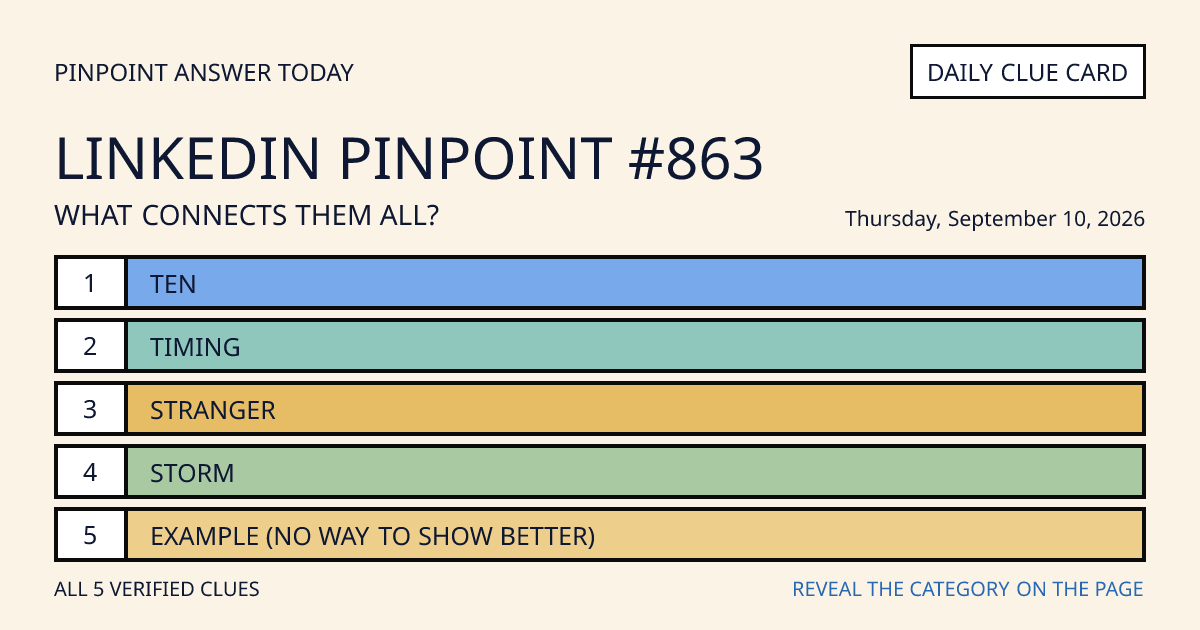
Pinpoint #863 opens with Ten, Timing, and Stranger. Compare all five clues below, then reveal the category and its connections.
AI-assisted explanation · automated checks ·
Original game: LinkedIn Pinpoint. Pinpoint Answer Today is an independent, unofficial puzzle guide. We are not affiliated with, sponsored by, or endorsed by LinkedIn or Microsoft.
Reveal answer & analysis
Answer: Words that come after “perfect”. Each clue supplies a noun that forms a familiar set phrase when preceded by “perfect”: perfect ten, perfect timing, perfect stranger, perfect storm, and perfect example. Seeing that multiple, unrelated clue words all become common collocations with the same lead word is the key move, and the list neatly spans numbers, people, weather, and demonstrations to confirm the shared entry point.
5 Clues
- Clue 1Ten
- Clue 2Timing
- Clue 3Stranger
- Clue 4Storm
- Clue 5Example (no way to show better)
Why this answer fits
A plausible alternate interpretation is “words that come after ‘ideal’,” since ideal timing or ideal example can sound reasonable in everyday speech. The third clue rules that out: “perfect stranger” is a standard, idiomatic phrase, while “ideal stranger” is not a comparable fixed expression. Once “perfect stranger” lands, the remaining clues also resolve cleanly into established collocations with “perfect,” making the intended connector straightforward rather than a trick definition.
Solving path for Pinpoint #863
- Initial reading: Start with clues 1–2 and look for a single modifier that naturally fronts both phrases: “perfect ten” and “perfect timing” are both common, self-contained expressions.
- Testing the connection: Use clue 3 as the anchor: “perfect stranger” is a fixed idiom, strongly indicating the repeated lead word is “perfect,” not a looser synonym like “ideal.”
- Final check: Confirm with clues 4–5: “perfect storm” and “perfect example” complete a consistent set of collocations, so the answer is the set of words that follow “perfect.”
Clue-by-clue explanation
| Clue | Connection evidence |
|---|---|
| Ten | Clue: Ten — The phrase “perfect ten” is a well-known collocation, so “ten” can be read as a word that comes after “perfect.” |
| Timing | Clue: Timing — “Perfect timing” is a standard expression for something happening at exactly the right moment, matching the pattern “perfect + noun.” |
| Stranger | Clue: Stranger — “Perfect stranger” is a common idiom for someone completely unknown, strongly supporting the idea of words that follow “perfect.” |
| Storm | Clue: Storm — “Perfect storm” is a widely used phrase for an especially bad or notable convergence of factors, fitting “perfect” directly before “storm.” |
| Example (no way to show better) | Clue: Example (no way to show better) — The wording points to “perfect example,” meaning an instance that illustrates something as well as possible, again placing the clue word after “perfect.” |
Questions about Pinpoint #863
What do Ten, Timing, and Stranger have in common? (answer spoiler)
The shared category is Words that come after “perfect”.
A plausible alternate interpretation is “words that come after ‘ideal’,” since ideal timing or ideal example can sound reasonable in everyday speech. The third clue rules that out: “perfect stranger” is a standard, idiomatic phrase, while “ideal stranger” is not a comparable fixed expression. Once “perfect stranger” lands, the remaining clues also resolve cleanly into established collocations with “perfect,” making the intended connector straightforward rather than a trick definition.
What does “Ten” mean in this puzzle? (answer spoiler)
Clue: Ten — The phrase “perfect ten” is a well-known collocation, so “ten” can be read as a word that comes after “perfect.”
What does “Timing” mean in this puzzle? (answer spoiler)
Clue: Timing — “Perfect timing” is a standard expression for something happening at exactly the right moment, matching the pattern “perfect + noun.”
Looking for today's puzzle?
This edition is dated Thursday, September 10, 2026. Visit today's Pinpoint answer for the latest edition, or browse the archive.
 X / Twitter
 LinkedIn
 Reddit