LinkedIn Pinpoint #849 Clue Walkthrough: Octopuses, Arctic hares (twice a year), Mood rings, Leaves (in autumn), Chameleons
Pinpoint answer #849, the LinkedIn Pinpoint solution, and a clue-by-clue solve path
Answer at a glance
LinkedIn Pinpoint #849 answer:
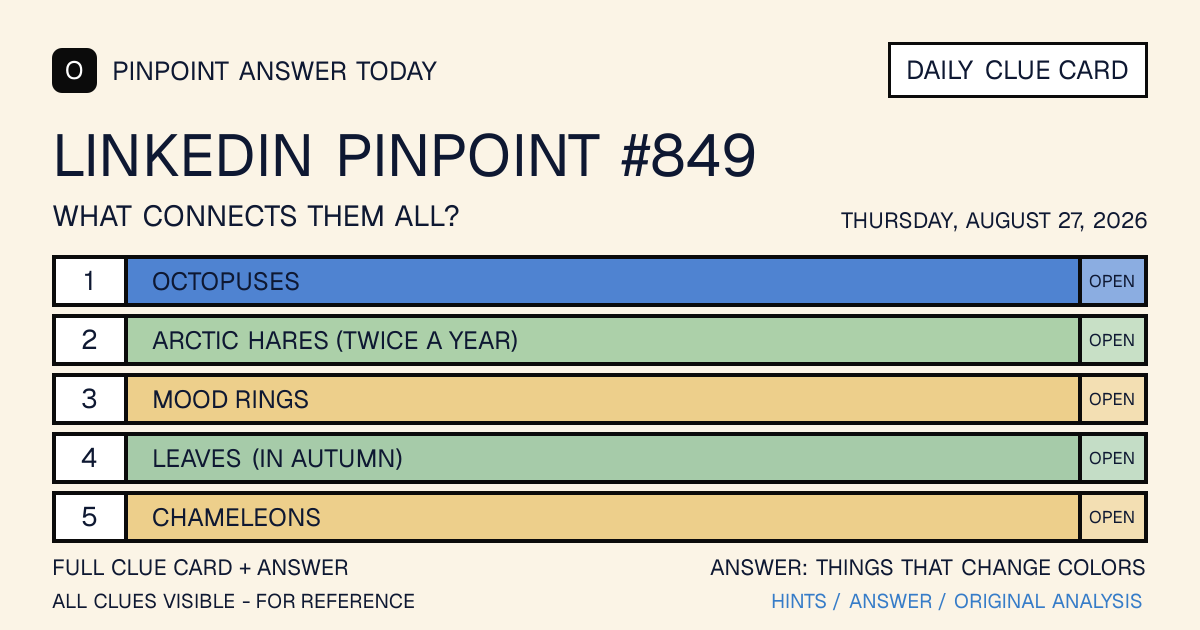
The answer to LinkedIn Pinpoint #849 is “Things that change colors.” Octopuses, Arctic hares, mood rings, autumn leaves, and chameleons all undergo visible color changes, although they do so through very different mechanisms—from rapid skin control and seasonal molting to temperature-sensitive materials and changing plant pigments.
Editorially reviewed by: Pinpoint Answer Today editorial team ·
Source: the public LinkedIn Pinpoint game. Our explanations and solving path are independently written; this site is not affiliated with LinkedIn or Microsoft.
Method: puzzle retrieval and formatting may be automated. New daily records are published only after their number, date, answer, and five clues pass completeness checks; the “editorially reviewed” label is added after every explanation and the three-step solve are checked individually. Read the verification method →
Latest edition: Looking for the current puzzle instead? See today's LinkedIn Pinpoint answer →
♧ 5 Clues
Why “Things that change colors” Connects All Five Clues
Octopuses and Arctic hares initially suggest animals changing color for camouflage, but Mood rings is the decisive category-breaking clue: it cannot molt or camouflage itself, yet its display shifts with temperature. Leaves and Chameleons then confirm that the connection is the shared visible result—changing color—rather than one biological mechanism.
Quick wink: The mood ring blamed the temperature, the leaf blamed the season, and the octopus had already matched the furniture.
Our Solve Experience for Pinpoint #849
Our first read: We start with Octopuses and Arctic hares. Both can change their outward coloration, although an octopus can do it rapidly while an Arctic hare in a seasonally changing population replaces its coat as winter and summer alternate.
What changed our mind: We use Mood rings as the pivot clue. Their temperature-sensitive material changes displayed color, so the category must extend beyond animals and camouflage to things that visibly change colors.
Our final check: We confirm with Leaves in autumn and Chameleons. Autumn foliage changes as leaf pigments shift, while chameleons alter skin coloration through pigmentary and light-reflecting structures, establishing the official answer “Things that change colors.”
Clue Evidence Table
| Clue | Connection evidence | Role in the solve |
|---|---|---|
| Octopuses | Octopuses can rapidly alter their appearance by expanding or contracting pigment-filled chromatophores under neural control, while reflective skin cells contribute additional brightness and iridescence for camouflage and communication. | Early anchor |
| Arctic hares (twice a year) | Arctic hares in populations with seasonal coat changes molt from gray-brown summer fur to white winter fur and back again, replacing their outward coloration twice each year to better match the landscape. | Early anchor |
| Mood rings | Mood rings contain thermochromic liquid crystals whose arrangement changes with temperature, shifting the wavelengths of light they reflect; the wearer’s skin temperature, rather than a direct reading of emotion, drives the color. | Cross-check |
| Leaves (in autumn) | Leaves change color in autumn as chlorophyll production declines and the green pigment breaks down, revealing yellow and orange carotenoids while some species also produce red or purple anthocyanins. | Cross-check |
| Chameleons | Chameleons can change skin coloration through interactions among pigment cells and reflective iridophores; in panther chameleons, changing the spacing of guanine nanocrystals shifts the wavelengths reflected during social displays. | Final confirmation |
References Used for Factual Checks
The puzzle number, clue wording, and category are checked against the public LinkedIn game. The references below support factual claims in our independent clue explanations.
- Smithsonian Ocean — How Octopuses and Squids Change ColorThe Smithsonian explains how chromatophores and reflective skin cells let octopuses rapidly change color for camouflage and signaling.
- Chemical & Engineering News — Chemistry in Pictures: Moody gooThe American Chemical Society publication explains that mood-ring liquid crystals change color with hand temperature rather than directly measuring emotion.
- U.S. Forest Service — Why Leaves Change ColorThe Forest Service describes chlorophyll loss and the pigments responsible for autumn leaf colors.
- Nature Communications — Photonic crystals cause active colour change in chameleonsThe peer-reviewed study shows how panther chameleons tune guanine nanocrystal spacing in iridophores to shift reflected color.
Frequently Asked Questions
What is the LinkedIn Pinpoint #849 answer?
The answer is “Things that change colors.”
What are the five clues for LinkedIn Pinpoint #849?
The five clues are Octopuses, Arctic hares (twice a year), Mood rings, Leaves (in autumn), Chameleons.
How do the clues connect in LinkedIn Pinpoint #849?
Octopuses and Arctic hares initially suggest animals changing color for camouflage, but Mood rings is the decisive category-breaking clue: it cannot molt or camouflage itself, yet its display shifts with temperature. Leaves and Chameleons then confirm that the connection is the shared visible result—changing color—rather than one biological mechanism.