LinkedIn Pinpoint #844 Hints & Answer: Crushing ice & Removing nails
You are viewing the Aug 22 puzzle, #844. View the latest Pinpoint answer
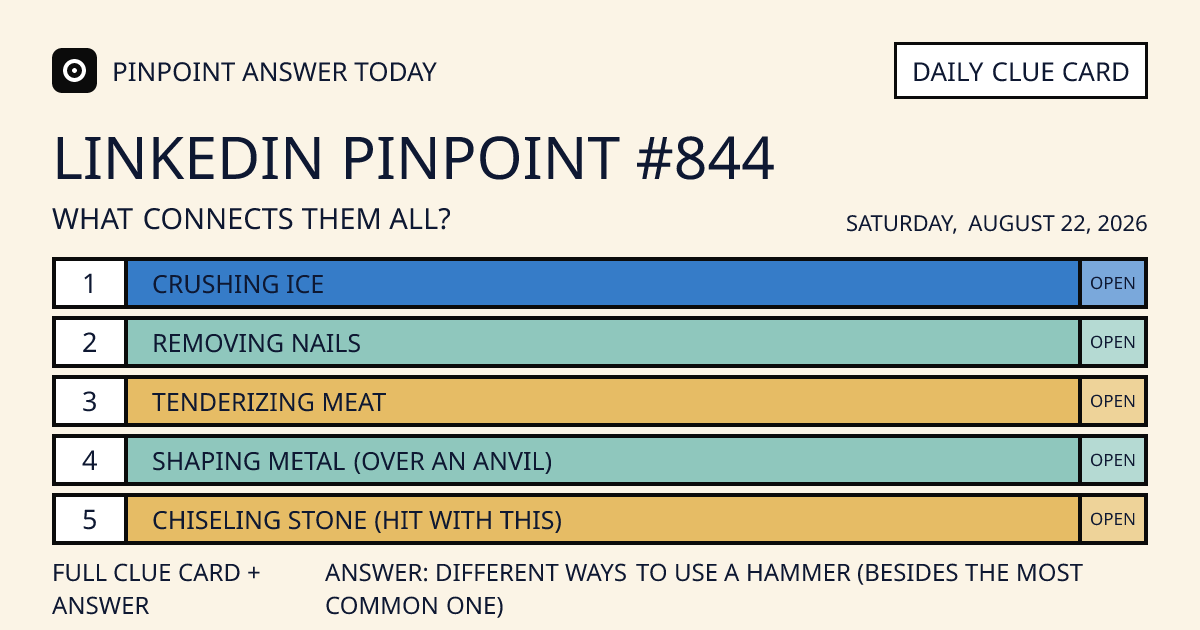
Pinpoint #844 opens with Crushing ice, Removing nails, and Tenderizing meat. Compare all five clues below, then reveal the category and its connections.
AI-assisted explanation · automated checks ·
Original game: LinkedIn Pinpoint. Pinpoint Answer Today is an independent, unofficial puzzle guide. We are not affiliated with, sponsored by, or endorsed by LinkedIn or Microsoft.
Reveal answer & analysis
LinkedIn Pinpoint #844 clues describe five less-obvious jobs for a hammer: crushing ice, pulling nails, tenderizing meat, shaping hot metal over an anvil, and striking a chisel while carving stone. Together they lead to “Different ways to use a hammer (besides the most common one).”
5 Clues
- Clue 1Crushing ice
- Clue 2Removing nails
- Clue 3Tenderizing meat
- Clue 4Shaping metal (over an anvil)
- Clue 5Chiseling stone (hit with this)
Why this answer fits
“Removing nails” is the best early anchor because a claw hammer performs the reverse of the tool’s familiar nail-driving job. Tenderizing meat and shaping metal then widen the idea from one household hammer to a family of striking tools, while the ice and stone clues confirm that the answer is about alternative hammer uses rather than construction alone.
Solving path for Pinpoint #844
- Initial reading: Start with “Removing nails.” The curved claw on a claw hammer grips a nail head and uses leverage to pull the nail out, immediately suggesting an uncommon hammer job.
- Testing the connection: Pair “Tenderizing meat” with “Shaping metal.” A meat mallet pounds tough fibers, while a smithing hammer moves heated metal against an anvil, so the category expands beyond carpentry.
- Final check: Confirm the tool with “Crushing ice” and “Chiseling stone.” A hammer or mallet can break ice directly and can strike a stone chisel, completing five ways to use a hammer besides driving a nail.
Clue-by-clue explanation
| Clue | Connection evidence |
|---|---|
| Crushing ice | A small hammer or mallet can break a block or large pieces of ice into smaller fragments for drinks, food preparation, or cold storage. |
| Removing nails | A claw hammer removes nails by catching the nail head in its split claw and using the curved head as a lever against the surface. |
| Tenderizing meat | A meat mallet is a hammer-shaped kitchen tool used to flatten meat and break down tough muscle fibers before cooking. |
| Shaping metal (over an anvil) | A blacksmith uses specialized hammers to move and shape heated metal while the anvil supplies a hard surface beneath the workpiece. |
| Chiseling stone (hit with this) | A sculptor or stonemason strikes the end of a chisel with a hammer or mallet so the chisel’s cutting edge chips and shapes the stone. |
What do Crushing ice, Removing nails, and Tenderizing meat have in common?
Reveal the shared connection for Pinpoint #844 (answer spoiler)
The shared category is Different ways to use a hammer (besides the most common one).
“Removing nails” is the best early anchor because a claw hammer performs the reverse of the tool’s familiar nail-driving job. Tenderizing meat and shaping metal then widen the idea from one household hammer to a family of striking tools, while the ice and stone clues confirm that the answer is about alternative hammer uses rather than construction alone.
What does “Crushing ice” mean in this puzzle? (answer spoiler)
A small hammer or mallet can break a block or large pieces of ice into smaller fragments for drinks, food preparation, or cold storage.
What does “Removing nails” mean in this puzzle? (answer spoiler)
A claw hammer removes nails by catching the nail head in its split claw and using the curved head as a lever against the surface.
Looking for today's puzzle?
This edition is dated Saturday, August 22, 2026. Visit today's Pinpoint answer for the latest edition, or browse the archive.
Sources — may contain answer spoilers
These references support the explanation notes; they do not certify human review.
- Smithsonian Institution — railroad mechanic’s hammerMuseum record documenting a heavy hammer used on bolts, rivets, chisels, piping, and other mechanical work.
 X / Twitter
 LinkedIn
 Reddit