LinkedIn Pinpoint #846 Hints & Answer: Krait & Copperhead
You are viewing the Aug 24 puzzle, #846. View the latest Pinpoint answer
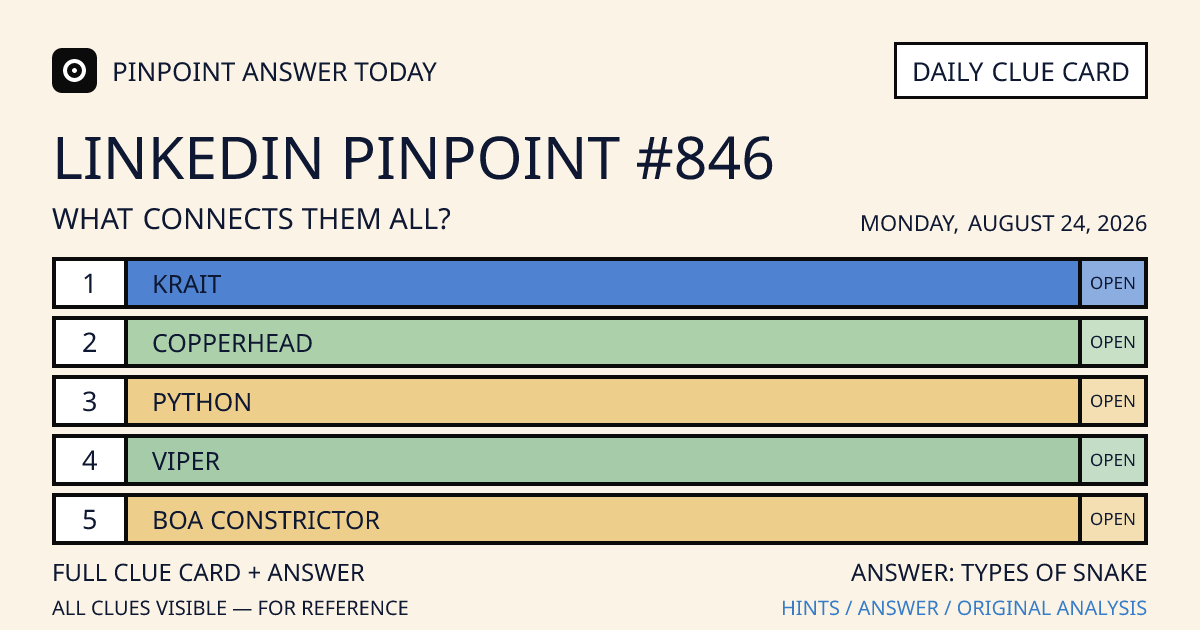
Pinpoint #846 opens with Krait, Copperhead, and Python. Compare all five clues below, then reveal the category and its connections.
AI-assisted explanation · automated checks ·
Original game: LinkedIn Pinpoint. Pinpoint Answer Today is an independent, unofficial puzzle guide. We are not affiliated with, sponsored by, or endorsed by LinkedIn or Microsoft.
Reveal answer & analysis
LinkedIn Pinpoint #846 clues—Krait, Copperhead, Python, Viper, and Boa constrictor—are all names for types of snake. The list mixes venomous snakes with nonvenomous constrictors, so the official category answer is “Types of snake.”
5 Clues
- Clue 1Krait
- Clue 2Copperhead
- Clue 3Python
- Clue 4Viper
- Clue 5Boa constrictor
Why this answer fits
Python and boa constrictor are the fastest pairing because both are famous nonvenomous constrictors. Krait and copperhead then prevent the category from narrowing to constrictors: both are venomous snakes from different parts of the world. Viper supplies the broad confirming label, showing that the connection is simply recognizable types of snake rather than one family, habitat, or hunting method.
Solving path for Pinpoint #846
- Initial reading: Start with Python and Boa constrictor. Both are large, nonvenomous snakes that subdue prey by constriction, making snakes the strongest immediate category.
- Testing the connection: Test Krait and Copperhead. A krait is a venomous Asian elapid, while a copperhead is a venomous North American pit viper, so the group cannot be limited to constrictors or one region.
- Final check: Use Viper as the confirmation clue. Vipers are venomous snakes known for long, hinged fangs, and all five clues therefore fit the official answer “Types of snake.”
Clue-by-clue explanation
| Clue | Connection evidence |
|---|---|
| Krait | Kraits are highly venomous elapid snakes in the genus Bungarus, found across parts of South and Southeast Asia and known for potent neurotoxic venom. |
| Copperhead | The copperhead is a venomous North American pit viper, recognizable by its copper-colored head and hourglass-shaped bands along the body. |
| Python | Pythons are nonvenomous snakes in the family Pythonidae; they typically ambush prey and coil around it to constrict it. |
| Viper | Vipers belong to the family Viperidae, a widespread group of venomous snakes equipped with long fangs that fold back when the mouth closes. |
| Boa constrictor | The boa constrictor is a large, nonvenomous snake native to the tropical Americas that kills prey by wrapping around it and constricting it. |
What do Krait, Copperhead, and Python have in common?
Reveal the shared connection for Pinpoint #846 (answer spoiler)
The shared category is Types of snake.
Python and boa constrictor are the fastest pairing because both are famous nonvenomous constrictors. Krait and copperhead then prevent the category from narrowing to constrictors: both are venomous snakes from different parts of the world. Viper supplies the broad confirming label, showing that the connection is simply recognizable types of snake rather than one family, habitat, or hunting method.
What does “Krait” mean in this puzzle? (answer spoiler)
Kraits are highly venomous elapid snakes in the genus Bungarus, found across parts of South and Southeast Asia and known for potent neurotoxic venom.
What does “Copperhead” mean in this puzzle? (answer spoiler)
The copperhead is a venomous North American pit viper, recognizable by its copper-colored head and hourglass-shaped bands along the body.
Looking for today's puzzle?
This edition is dated Monday, August 24, 2026. Visit today's Pinpoint answer for the latest edition, or browse the archive.
Sources — may contain answer spoilers
These references support the explanation notes; they do not certify human review.
- Smithsonian’s National Zoo — Northern copperheadCopperhead classification, range, markings, and venom.
- Smithsonian’s National Zoo — Boa constrictorBoa classification, range, and constriction behavior.
 X / Twitter
 LinkedIn
 Reddit