# 819Places & geographyNamed set

LinkedIn Pinpoint #819 Hints & Answer: Batman & Samsun

Pinpoint answer #819, the LinkedIn Pinpoint solution, and a clue-by-clue solve path

Updated Aug 24, 12:00 AM PDT: LinkedIn Pinpoint #819 (Jul 28) begins with “Batman” and “Samsun.” Reveal the remaining clues and verified category only when you are ready.

Answer at a glance

LinkedIn Pinpoint #819 answer:

LinkedIn Pinpoint #819 lists Batman, Samsun, Antalya, Ankara, and Istanbul. Despite the comic-book misdirection created by the first clue, every name belongs to a city in the same country, giving the answer “Cities in Türkiye.”

Edited reference guide · AI-assisted ·

Original game: LinkedIn Pinpoint. Our explanations and solving path are independently written; this site is not affiliated with LinkedIn or Microsoft.

The reasoning below is an explanatory route through the clues, not a record of a person's live attempt. Sources, automation and limits →

Latest edition: Looking for the current puzzle instead? See today's LinkedIn Pinpoint answer →

♧ 5 Clues

Why “Cities in Türkiye!” Connects All Five Clues

Batman is deliberately difficult because its more famous fictional association hides the geographic reading. Ankara and Istanbul provide the fastest country-level anchors; Antalya then supports the same interpretation from the Mediterranean coast, while Samsun and Batman broaden the set beyond Türkiye’s most internationally familiar cities.

A Reasoning Path for Pinpoint #819

Step 1: Begin with Ankara and Istanbul. Recognizing Türkiye’s capital and its largest city establishes “cities in Türkiye” as a strong working category.

Step 2: Test Antalya and Samsun geographically. Antalya is a Turkish Mediterranean city, while Samsun is a Turkish city on the Black Sea coast, so both support the same country.

Step 3: Reconsider Batman as a place name rather than a fictional character. Batman is also a city in southeastern Türkiye, completing the five-city set.

Clue Evidence Table

ClueConnection evidenceReveal order
BatmanBatman is a city in southeastern Türkiye and serves as the administrative center of the province that shares its name.Clue 1 of 5
SamsunSamsun is a Turkish port city on the Black Sea coast, placing it in the northern part of the country.Clue 2 of 5
AntalyaAntalya is a city on Türkiye’s Mediterranean coast and one of the best-known urban centers in that coastal region.Clue 3 of 5
AnkaraAnkara is the national capital of Türkiye, making it one of the clearest clues for identifying the shared country.Clue 4 of 5
IstanbulIstanbul is Türkiye’s largest city and extends around the Bosporus, with districts on both the European and Asian sides.Clue 5 of 5

Frequently Asked Questions

What are the opening clues for LinkedIn Pinpoint #819?

The opening clues are Batman and Samsun. The puzzle contains five clues in total.

How can I test a possible connection for Batman and Samsun?

Consider literal meanings, familiar phrases, and shared categories. Test your proposed rule against each remaining clue; reject it if a clue needs a different rule to fit.

Can I reveal clues before the answer in Pinpoint #819?

Yes. Select a covered clue to reveal clues up to that point. The Reveal answer button is separate, so revealing a clue does not reveal the category in the puzzle card. The explanation section below contains spoilers.
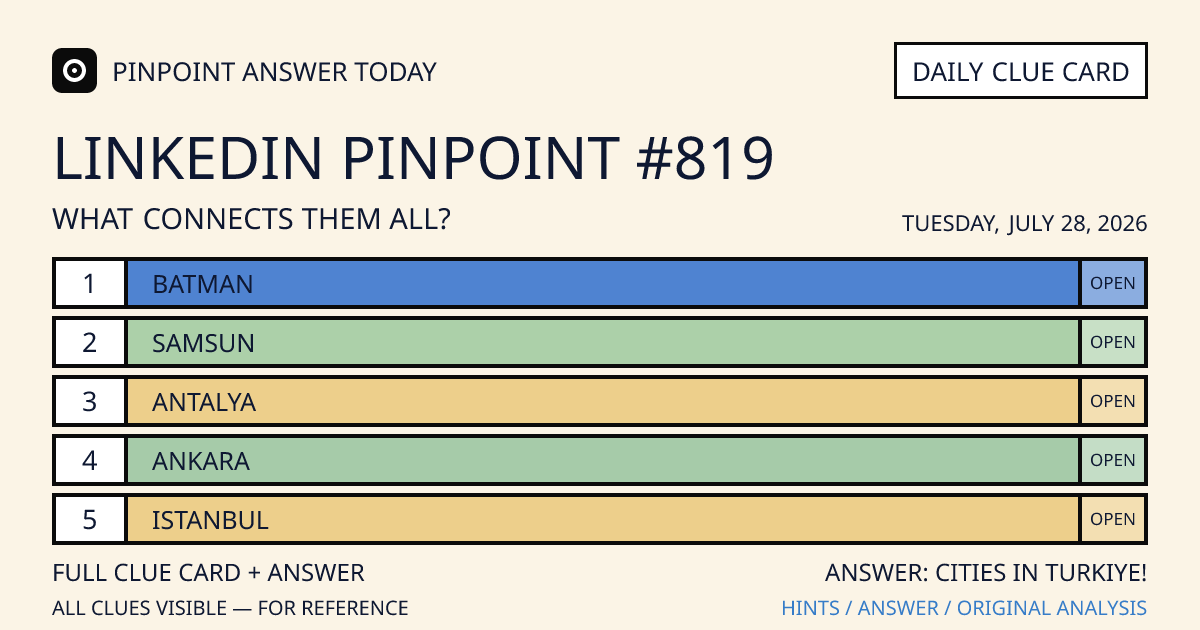
LinkedIn Pinpoint #819 clue card for Tuesday, July 28, 2026, beginning with “Batman”
Complete clue card for LinkedIn Pinpoint #819 on Tuesday, July 28, 2026, with all five clues and the answer visible for reference.
Share:↓ Daily image↗ X / Twitter↗ LinkedIn↗ Reddit

Hints, not spoilers

Game strategy

Generated by Gemini

Welcome to our strategy guide for LinkedIn’s Pinpoint. This daily puzzle gives you five clues and challenges you to find the single category that unites them all. Unlike grouping games, your goal is not to divide a board into several sets. The entire puzzle is five clues, one hidden connection. Success requires logic, lateral thinking, and a willingness to reconsider an early idea. The clue board on our homepage shows all five clues at once, allowing you to see the full picture as you apply these techniques.

Understanding the five-clue connection

The fundamental rule of Pinpoint is that the category must describe all five clues. There are no spare clues to discard. If your theory works for four but feels forced for the fifth, treat that mismatch as a reason to investigate further rather than ignore it.

Your goal is to discover the specific connection that encompasses the complete set. Write your idea as a short category description, then explain how each clue belongs. This separates a promising connection from a vague association that could cover almost anything.

Think flexibly: explore multiple meanings

A clue can refer to an object, an action, a name, or part of a familiar expression. Before settling on one interpretation, ask what other contexts it could appear in. A dictionary can help when a less familiar meaning seems relevant, but do not assume the first definition is the intended one.

For a hypothetical example, PITCHER could mean a baseball player or a container for liquids. Nearby clues might suggest one meaning, but neither interpretation is confirmed until the proposed category also explains the complete set. Keep a second possibility in mind instead of locking into your first impression.

Identify the kind of connection

While answers change daily, recurring types of connections can guide your brainstorming. Start with a literal category: are the clues names of related objects, people, activities, or places? Then consider a shared property or parts of something larger.

If these approaches do not work, consider familiar expressions, alternate meanings, or wordplay. Spelling and sound may be worth investigating, but do not assume that an accidental shared letter is enough. Your explanation should make sense of the actual clues, not just match a tiny feature that thousands of unrelated words also share.

Try the before-and-after test

Some connections involve clues that can all precede or follow another word. Ask: is there one word that can be placed before each clue to form a familiar word or phrase? Then test the opposite direction. Check the meaning of every resulting expression, not just whether it sounds plausible.

For a hypothetical example, BOW, COAT, DROP, FALL, and FOREST can follow RAIN: rainbow, raincoat, raindrop, rainfall, and rainforest. This example illustrates the method; it is not a claim about today’s puzzle. A useful test must work naturally across the full set.

Avoid forcing the last clue

A common pitfall is finding a convincing connection for several clues and stretching the remaining clue to fit. Instead, make that awkward clue your next starting point. Does it have another meaning? Does it suggest a more precise version of your category?

A mismatch can mean your theory is wrong, but it can also mean you have not recognized an intended reference. Compare alternatives before concluding. On our homepage, the complete clue board lets you check each clue without switching between pages.

How crossword solver tools differ

Crossword tools often use an answer length and a pattern of known letters to find candidate words. Some also interpret clue text. Those features address a different task from Pinpoint, where you are identifying a category shared by several clues rather than filling a fixed set of squares.

A dictionary or synonym lookup can still clarify an unfamiliar clue. However, a matching word from a crossword tool does not establish the connection between all five clues. This site’s strategy drawer provides reading guidance and links to practice; it is not an interactive crossword solver.

Practice deliberately and use hints thoughtfully

A useful practice habit is to form a few hypotheses, then check them against the remaining clues. The official game reveals clues progressively; our homepage displays the full set. If you prefer a gradual challenge, try the practice page linked below.

When you reveal an answer, take a moment to understand each connection rather than only memorizing the category. Note which clue changed your thinking and what assumption held you back. Explaining your reasoning to someone else can also expose a weak link and suggest a different interpretation.

FAQ: what if a clue is unfamiliar?

Begin with the clues you understand and treat their connection as provisional. Look up the unfamiliar term when necessary, then return to the whole set. Do not discard a clue simply because it is obscure or assume it must support your current guess.

If several categories seem possible, compare their specificity. Which one explains all five clues with the fewest extra assumptions? Viewing the official solution or our explanation can help resolve uncertainty, but an AI-written explanation should still be checked when a factual detail seems questionable.

FAQ: does every connection depend on definitions?

Not necessarily. Familiar phrases and wordplay can be relevant alongside literal meanings. Consider how words are used together, as well as what each word describes. Avoid narrowing the search too early to only one type of relationship.

Idioms, proper names, and cultural references may require knowledge you do not yet have. That is an opportunity to learn rather than a reason to force a guess. Use an appropriate reference source, compare the explanation with all five clues, and keep the distinction between a verified fact and a tentative interpretation clear.