LinkedIn Pinpoint #923 Hints & Answer: Temperature & Humidity
You are viewing the Nov 9 puzzle, #923. View the latest Pinpoint answer
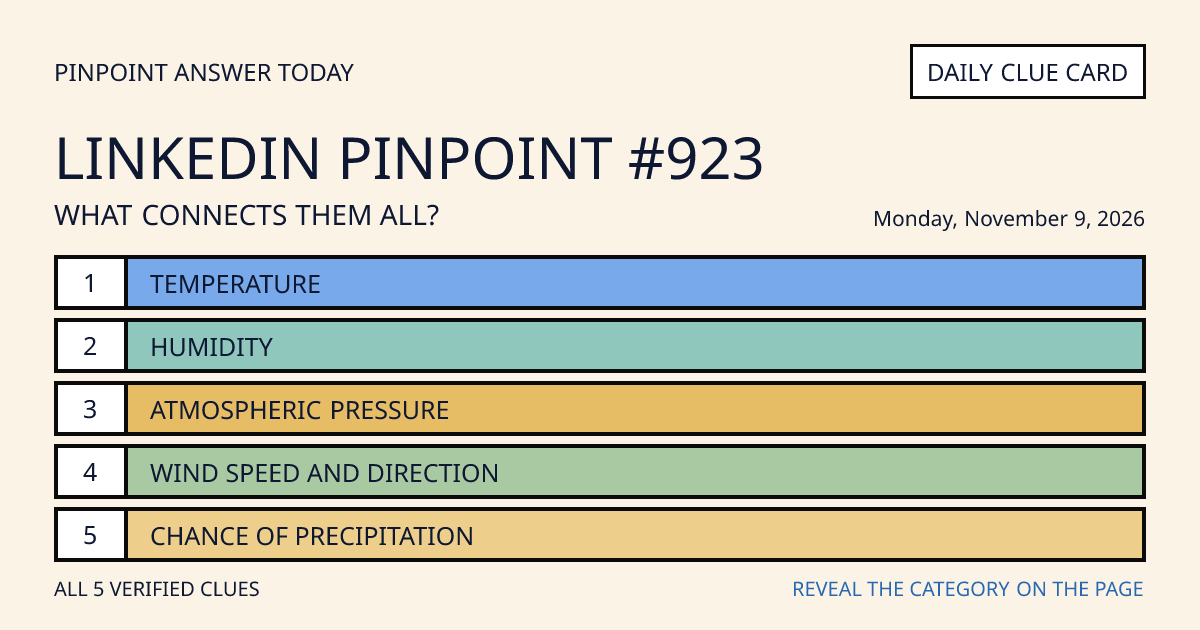
Pinpoint #923 opens with Temperature, Humidity, and Atmospheric pressure. Compare all five clues below, then reveal the category and its connections.
AI-assisted explanation · automated checks ·
Original game: LinkedIn Pinpoint. Pinpoint Answer Today is an independent, unofficial puzzle guide. We are not affiliated with, sponsored by, or endorsed by LinkedIn or Microsoft.
Need a hint first?
Reveal one hint at a time.
Hint 1 — a direction to explore
Think of a standardized set of environmental measurements people check before going outside.
Hint 2 — narrow the relationship
These are typical fields shown together in many location-based conditions apps and daily reports.
Hint 3 — one more nudge
Include airflow details and a stated likelihood of wetness, not just heat and moisture.
First two clues: possible connections
Temperature and Humidity can describe many settings: building comfort controls, greenhouse monitoring, manufacturing specs, or general environmental measurements. Those two alone don’t uniquely determine the category, because plenty of dashboards and checklists track both without implying any specific kind of public report.
Reveal answer & analysis
All five clues are standard metrics commonly listed as parts of a weather forecast describing outdoor conditions over time.
5 Clues
- Clue 1Temperature
- Clue 2Humidity
- Clue 3Atmospheric pressure
- Clue 4Wind speed and direction
- Clue 5Chance of precipitation
Why this answer fits
The first two clues could fit many “comfort” or lab-measurement contexts, so they don’t lock in a single theme. Adding Atmospheric pressure and Wind speed and direction points strongly to meteorological reporting, and Chance of precipitation confirms the common public-facing bundle. The relationship is not wordplay—each clue is literally a reported component of the same kind of report.
Solving path for Pinpoint #923
- Initial reading: Start by listing plausible contexts for Temperature and Humidity (indoor comfort, lab/environmental monitoring, outdoor conditions), since those two alone are compatible with many categories.
- Testing the connection: Test a candidate context against Atmospheric pressure and Wind speed and direction, which are strongly associated with meteorological reporting rather than most indoor or industrial readouts.
- Final check: Verify scope with Chance of precipitation, then check that the final category naturally includes all five items as standard report components.
Clue-by-clue explanation
| Clue | Meaning in this puzzle | Connection & role in the solve |
|---|---|---|
| Temperature | Forecast temperatureThe predicted or current air temperature, often summarized as a present value plus a day’s high and low range for a location. | Temperature fits because Temperature is routinely included in parts of a weather forecast as a headline condition value. |
| Humidity | Forecast humidityThe reported moisture content of the air, typically given as relative humidity to indicate how dry or muggy conditions may feel. | Humidity fits because Humidity is commonly reported in parts of a weather forecast to describe how much moisture is in the air. |
| Atmospheric pressure | Barometric pressure readingA measured air-pressure value at or adjusted to a standard reference level, used to describe broader atmospheric conditions and changes. | Atmospheric pressure fits because Atmospheric pressure is a standard meteorological reading that appears in parts of a weather forecast and related displays. |
| Wind speed and direction | Wind: speed and directionA report of wind velocity together with the compass direction the wind is coming from, often shown with arrows and units. | Wind speed and direction fits because Wind speed and direction is a basic line item in parts of a weather forecast for describing airflow at a place and time. |
| Chance of precipitation | Probability of precipitationA stated likelihood, over a defined period, that measurable rain, snow, or similar precipitation will occur at a given location. | Chance of precipitation fits because Chance of precipitation is a familiar probability figure included in parts of a weather forecast for planning around wet conditions. |
One lesson to use next time
When a set starts with broad measurements like temperature and humidity, look for later clues that specify the reporting context—adding pressure, wind, and precipitation narrows it cleanly to parts of a weather forecast.
What do Temperature, Humidity, and Atmospheric pressure have in common?
Reveal the shared connection for Pinpoint #923 (answer spoiler)
The shared category is Parts of a weather forecast.
The first two clues could fit many “comfort” or lab-measurement contexts, so they don’t lock in a single theme. Adding Atmospheric pressure and Wind speed and direction points strongly to meteorological reporting, and Chance of precipitation confirms the common public-facing bundle. The relationship is not wordplay—each clue is literally a reported component of the same kind of report.
What does “Temperature” mean in this puzzle? (answer spoiler)
Forecast temperature: The predicted or current air temperature, often summarized as a present value plus a day’s high and low range for a location. Temperature fits because Temperature is routinely included in parts of a weather forecast as a headline condition value.
What does “Humidity” mean in this puzzle? (answer spoiler)
Forecast humidity: The reported moisture content of the air, typically given as relative humidity to indicate how dry or muggy conditions may feel. Humidity fits because Humidity is commonly reported in parts of a weather forecast to describe how much moisture is in the air.
Looking for today's puzzle?
This edition is dated Monday, November 9, 2026. Visit today's Pinpoint answer for the latest edition, or browse the archive.
 X / Twitter
 LinkedIn
 Reddit