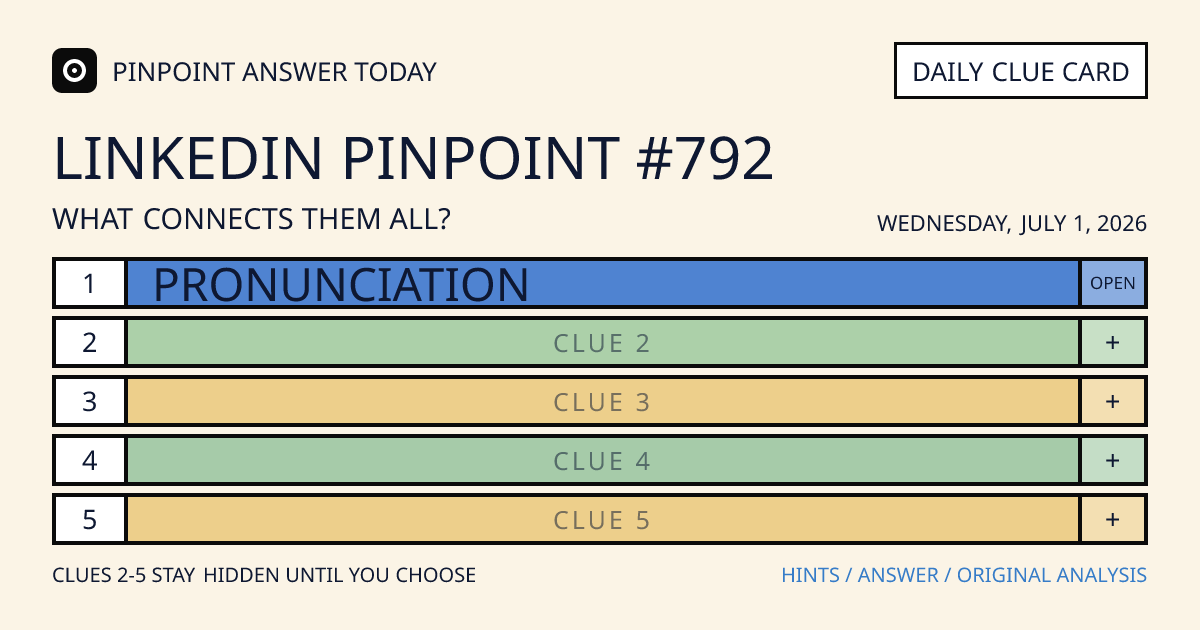
LinkedIn Pinpoint Answer #792 — Wednesday, July 1, 2026
Pinpoint answer #792, the LinkedIn Pinpoint solution, and a clue-by-clue solve path
Editorially reviewed by: Pinpoint Answer Today editorial team ·
Source: the public LinkedIn Pinpoint game. Our explanations and solving path are independently written; this site is not affiliated with LinkedIn or Microsoft.
♧ 5 Clues
How to Find the Pinpoint Answer for Puzzle #792
The LinkedIn Pinpoint answer for puzzle #792 is “Parts of a dictionary entry”. Pronunciation, etymology, part of speech, an example sentence, and a definition are standard pieces of information assembled in a dictionary entry.
Quick wink: Definition did the actual explaining, Etymology supplied the backstory, and Pronunciation kept tapping the microphone to ask whether it was on.
Clue-by-Clue Explanation
1. Pronunciation: Pronunciation guides show how a headword is spoken, often with phonetic symbols or audio.
2. Etymology: Etymology traces a word’s origin and the earlier forms from which it developed.
3. Part of speech: The part of speech labels a word as a noun, verb, adjective, or another grammatical class.
4. Example sentence: An example sentence demonstrates the word’s meaning and grammar in a realistic context.
5. Definition: A definition states the meaning of the headword or of one particular sense of it.
How We Solved Pinpoint #792
- Step 1: Pair Definition with Pronunciation, two features readers routinely consult in a dictionary.
- Step 2: Add Part of speech and Example sentence, which explain how the headword functions and appears in context.
- Step 3: Use Etymology as the final confirmation: dictionaries often record a word’s linguistic origin and development.
Final check: Definition and pronunciation are the clearest anchors. Part of speech and example sentence establish the entry’s structure, while etymology adds the word’s historical origin.
Want to solve another one?
Next Random Puzzle →